
The Cost of Truck Rolls vs Remote Video Assistance: How You Can Save Big in Service Visits

Sending a service truck to a customer site is often necessary but comes with a high price tag. Many industries face significant expenses when dispatching technicians for on-site visits, commonly called "truck rolls." These costs add up quickly and impact both service providers and customers. Fortunately, remote video assistance offers a cost-effective alternative that can reduce or even eliminate many truck rolls. This post explores the real costs of truck rolls, compares them to the affordable price of remote video assistance licenses, and shows how businesses can save money while improving service quality.

What Is a Truck Roll and Why Does It Cost So Much?
A truck roll refers to sending a technician or service professional to a customer’s location to perform installation, maintenance, or repair. This is common in industries like telecommunications, utilities, IT services, and home appliance repair.
The costs involved in a truck roll include:
Labor: Technician wages for travel time and on-site work
Vehicle expenses: Fuel, maintenance, depreciation
Logistics: Scheduling, dispatch coordination, and administrative overhead
Parts and tools: Sometimes technicians carry replacement parts or specialized tools
Industry Estimates of Truck Roll Costs
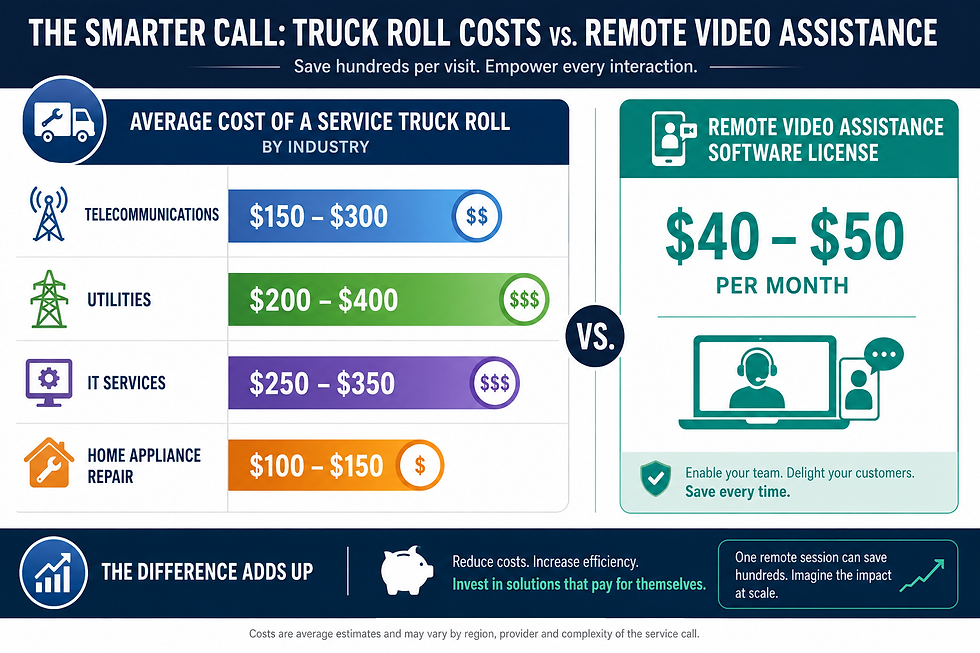
Telecommunications: According to a 2021 report by Heavy Reading, the average truck roll cost for telecom providers ranges from $150 to $300 per visit. This includes labor and vehicle costs.
Utilities: The Edison Electric Institute estimates that utility truck rolls cost between $200 and $400, depending on the complexity of the service.
IT Services: A 2020 survey by HDI found that the average cost of an on-site IT service visit is about $250 to $350.
Home Appliance Repair: According to HomeAdvisor, the average service call fee (truck roll) is around $100 to $150, excluding parts.
These numbers show that a single truck roll can easily cost a business a few hundred dollars. Multiply that by hundreds or thousands of service calls annually, and the expenses become substantial.
How Remote Video Assistance Works
Remote video assistance uses live video streaming technology to connect a technician with a customer or on-site staff. The technician can see the problem in real time, guide the user through troubleshooting steps, or diagnose issues without physically being there.
This technology typically requires:
A smartphone, tablet, or computer with a camera
A secure video assistance platform or app
A subscription or license fee for the software
Remote video assistance can resolve many issues remotely, reducing the need for truck rolls.
Comparing Costs: Truck Rolls vs Remote Video Assistance
Let’s compare the costs side by side using real numbers.
|
What This Means in Practice
If a company sends out just one truck roll per month, the cost ranges from $100 to $400.
A remote video assistance license at $40 per month is a fraction of that cost.
Even if multiple remote sessions are needed, the monthly fee remains fixed, making it highly cost-effective.
Real-World Savings Examples
Example 1: Telecom Provider
A telecom company handles 500 service calls monthly. If 60% of these calls require truck rolls at an average cost of $200 each, the monthly truck roll expense is:
500 calls × 60% × $200 = $60,000
If remote video assistance can reduce truck rolls by 50%, the company saves:
250 fewer truck rolls × $200 = $50,000
The cost of remote video assistance licenses for 500 users at $40 each is:
500 × $40 = $20,000
Net savings: $50,000 - $20,000 = $30,000 per month
Example 2: Utility Company
A utility company dispatches trucks for 1,000 service visits monthly at an average cost of $300 per truck roll:
1,000 × $300 = $300,000
Using remote video assistance to cut truck rolls by 40% saves:
400 fewer truck rolls × $300 = $120,000
Assuming 1,000 licenses at $40 each:
1,000 × $40 = $40,000
Net savings: $120,000 - $40,000 = $80,000 per month
Additional Benefits of Remote Video Assistance
Beyond cost savings, remote video assistance offers other advantages:
Faster resolution times: Technicians can diagnose and fix issues immediately without travel delays.
Improved customer satisfaction: Customers get quicker help and avoid waiting for appointments.
Reduced carbon footprint: Fewer truck rolls mean less fuel consumption and emissions.
Better resource allocation: Technicians focus on complex issues that truly require on-site visits.
When Truck Rolls Are Still Necessary
Remote video assistance cannot replace every truck roll. Some situations require physical presence, such as:
Hardware replacements or installations
Safety inspections
Complex repairs needing specialized tools
However, many routine diagnostics and minor fixes can be handled remotely.
How to Implement Remote Video Assistance in Your Service Model
Choose the right platform: Look for secure, easy-to-use video assistance software with features like session recording and annotation.
Train your team: Ensure technicians and customer service reps know how to use the technology effectively.
Educate customers: Provide clear instructions on how to connect for remote assistance.
Track metrics: Monitor truck roll reduction rates, customer satisfaction, and cost savings to measure success.
Using remote video assistance can transform your service operations by cutting costs and improving efficiency. The numbers clearly show that investing $40-$50 per month in a video assistance license can save hundreds or thousands in truck roll expenses.